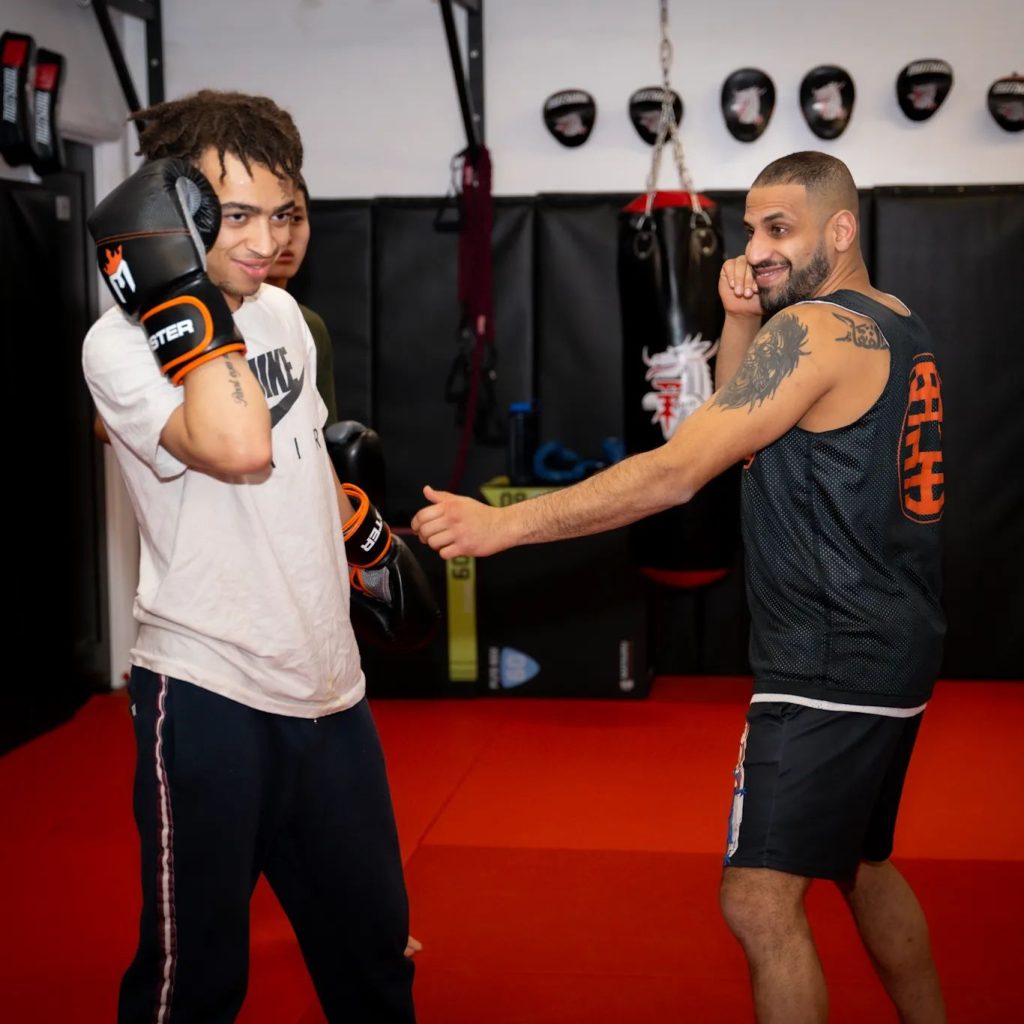


The teenage years are filled with challenges that can feel very different from those experienced during childhood. Academic expectations increase. Friendships become more complicated. Teens begin thinking about future education, careers, independence, and their place in the world. At the same time, they are learning how to deal with disappointment, pressure, uncertainty, and situations that do not always go according to plan.
Parents cannot remove every challenge their teenagers will face—and doing so would not necessarily prepare them for adulthood.
What teens can develop is greater confidence in their ability to face difficult situations, work through frustration, make adjustments, and continue moving forward.
Martial arts provides an environment where these qualities can be practiced regularly.
At Elevate MMA, our martial arts training gives teens in Ottawa, Orleans, Kanata, and surrounding communities opportunities to challenge themselves physically and mentally within a structured setting. Training is not about eliminating difficulty. It is about gradually becoming more comfortable dealing with it.
Challenges Feel Different When You Have Experience Overcoming Them
When teenagers encounter something difficult, the initial reaction may be uncertainty.
“What if I can’t do this?”
“What if I make a mistake?”
“What if everyone else is better?”
These thoughts can prevent young people from trying things that would otherwise help them grow.
Martial arts creates manageable challenges almost every class.
A new technique may feel confusing.
A conditioning exercise may be demanding.
A student might struggle to coordinate a combination.
A grappling position may take several attempts to understand.
Then something important happens.
They practice.
What initially seemed impossible begins becoming familiar.
That experience teaches teens that difficulty at the beginning does not determine the eventual outcome.
Martial Arts Changes the Meaning of “I Can’t”
Teenagers sometimes interpret difficulty as evidence that they lack ability.
If something does not work immediately, the conclusion can become, “I’m not good at this.”
Martial arts challenges that assumption.
Techniques are not expected to be perfect the first time.
A student may need dozens—or hundreds—of repetitions before a movement begins feeling natural.
The more useful question becomes:
“What do I need to improve?”
That small change in thinking can be powerful.
Instead of treating current ability as permanent, teens begin seeing improvement as something they can influence through effort and practice.
Becoming Comfortable With Being a Beginner
Nobody enjoys feeling inexperienced.
For teenagers, who can be particularly conscious of how they appear to their peers, trying something unfamiliar may feel intimidating.
Martial arts provides repeated exposure to being a beginner.
Students do not know every technique.
They will make mistakes.
They will need help.
They may occasionally forget something that was explained only minutes earlier.
And all of that is normal.
When teens discover that they can make mistakes without the world ending, trying new things can become less threatening.
Difficult Does Not Mean Dangerous
An important part of personal development is learning the difference between a situation that is challenging and one that is genuinely unsafe.
Martial arts can introduce controlled physical challenges while maintaining rules, coaching, and appropriate boundaries.
A difficult drill might be tiring.
Learning an unfamiliar movement might be frustrating.
Working with a more experienced training partner might require extra concentration.
These experiences allow teens to become more comfortable with manageable discomfort.
At the same time, responsible training teaches them to respect safety expectations and communicate when something is wrong.
The goal is not to ignore limits. It is to develop a more thoughtful relationship with challenge.
Learning to Stay With a Problem
Modern life makes it easy to move away from something the moment it becomes frustrating.
A video becomes boring? Swipe.
A game becomes difficult? Play something else.
A task takes too long? Find another distraction.
Martial arts does not provide instant solutions.
If a technique is difficult, students need to stay with it.
They watch the demonstration again.
They ask a question.
They make an adjustment.
They practice.
That experience can help teens become more comfortable remaining engaged with a problem instead of immediately abandoning it.
Failure Becomes Information
One of the healthiest lessons martial arts can teach is that unsuccessful attempts contain useful information.
Suppose a student tries a technique and it does not work.
Instead of stopping there, the coach can help them investigate.
Was their position incorrect?
Did they lose their balance?
Was the timing off?
Did they rush?
Was an important step missing?
Suddenly, failure becomes feedback.
The student has something specific to improve.
This approach can help teenagers understand that getting something wrong does not automatically mean they are incapable.
Sometimes it simply shows them what needs attention next.
Feedback Becomes Less Personal
Receiving correction can be difficult during adolescence.
A teenager may hear “change this part of the technique” and emotionally interpret it as “you’re bad at this.”
Regular martial arts training can gradually separate those ideas.
Everyone receives corrections.
Beginners receive them.
Experienced students receive them.
Coaches themselves continue learning.
Technical feedback is simply part of skill development.
Over time, teens can become more comfortable hearing constructive criticism, processing it, and making an adjustment without allowing the correction to define their confidence.
Progress Requires Patience
Teenagers are surrounded by instant results.
Messages arrive immediately.
Entertainment is available instantly.
Information can be found within seconds.
Physical skills operate differently.
There is no button that instantly provides excellent footwork, striking technique, grappling ability, balance, or conditioning.
These abilities develop through practice.
Martial arts therefore provides practical experience with delayed gratification.
Students begin understanding that meaningful progress may require weeks, months, and eventually years.
Learning to value that process can prepare teens for many challenges they will face later in life.
Handling Frustration Without Quitting
Every martial arts student eventually has a frustrating class.
Something that worked last week suddenly feels difficult.
A new technique does not make sense.
The student feels tired.
Another person appears to be progressing faster.
These moments reveal something important.
What does the student do next?
They can become angry.
They can give up.
Or they can take a moment, listen to coaching, and continue working.
Martial arts gives teenagers repeated opportunities to practice that third response.
Confidence Comes From Evidence
Teenagers are often told to “believe in themselves.”
Encouragement matters, but genuine confidence becomes much stronger when it is supported by experience.
Martial arts gives teens evidence.
They remember being unable to perform a technique.
Now they can.
They remember becoming exhausted early in class.
Now their conditioning has improved.
They remember feeling nervous around unfamiliar training partners.
Now they are comfortable participating.
These experiences create confidence that is based on actual development.
The teen can look backward and see proof that effort changed what they were capable of doing.
Physical Challenges Can Build Mental Persistence
There are moments during training when the body becomes tired before class is finished.
Maintaining technique under fatigue requires concentration.
Teens learn that feeling tired does not necessarily mean they have to mentally disengage.
They can continue listening.
They can control their movement.
They can focus on technique rather than becoming careless.
This should never mean ignoring injury or concerning pain. Responsible training respects physical limits.
The lesson is about maintaining composure through ordinary effort and fatigue, not pushing through unsafe situations.
Martial Arts Can Help Teens Manage Performance Pressure
School can create considerable performance pressure.
Grades, exams, presentations, university applications, sports, and extracurricular activities can make teenagers feel that every outcome matters enormously.
Martial arts provides another environment where performance exists but mistakes are expected.
A student can attempt something, get it wrong, receive feedback, and try again.
There is another repetition.
Another drill.
Another class.
That repeated cycle can make setbacks feel less final.
Instead of viewing one poor performance as a disaster, teens can learn to see it as one moment within a longer process.
Learning to Control What You Can
Teenagers will encounter situations they cannot completely control.
They cannot control another person’s opinion.
They cannot guarantee the result of every exam.
They cannot make every friendship work.
They cannot prevent every unexpected change.
Martial arts contains similar uncertainty on a smaller scale.
Students cannot completely control how a partner moves.
What they can control is their own response.
Their positioning.
Their attention.
Their effort.
Their breathing.
Their decision-making.
This teaches an important principle: when the situation itself cannot be controlled, focus on what you can influence.
Staying Calm Makes Problems Easier to Solve
Stress can narrow attention.
When people panic, they often stop noticing useful options.
Martial arts makes this easy to observe.
A beginner in an unfamiliar grappling position may tense every muscle and attempt to escape through force.
With experience, they can begin recognizing the position.
Instead of panicking, they think.
Where should the hands go?
How can space be created?
What did the coach teach?
Calmness does not magically solve the problem, but it makes better decision-making possible.
Learning to Reset After a Mistake
A mistake can sometimes affect everything that happens afterward.
A teenager becomes frustrated by one error, keeps thinking about it, and then makes several more.
Martial arts encourages a reset.
The combination did not work?
Return to stance.
The technique failed?
Re-establish position.
The previous round was difficult?
The next one begins fresh.
This ability to mentally reset is useful far beyond martial arts.
Not every bad moment needs to become a bad day.
Comparison Becomes Less Useful
Teenagers naturally compare themselves with other people.
Social media can make this even more intense because young people constantly see carefully selected versions of other people’s lives and achievements.
Martial arts provides a clearer demonstration of why comparison can be misleading.
One student may have trained for three years.
Another may have started three weeks ago.
One person may naturally be more athletic.
Another may learn technical concepts quickly.
Comparing the two tells us very little.
The more useful measurement is personal development.
Are you better than you were last month?
That question keeps attention on progress rather than status.
Training Can Encourage Humility
Confidence is important, but so is humility.
Martial arts provides both.
A teenager may become good at a particular technique and then train with someone who understands it better.
They may feel physically strong but discover that technique can create problems strength alone cannot solve.
They may enter class believing they understand something and then learn an important detail they had completely missed.
There is always another level of understanding.
Recognizing that can help teens become confident without believing they already know everything.
Challenges Become Something to Explore
Over time, an interesting shift can occur.
Instead of avoiding difficulty, students may become curious about it.
A challenging technique becomes something to solve.
A demanding drill becomes something to improve at.
A weakness becomes an area worth developing.
That is a significant change.
The teenager is no longer asking only, “Can I avoid this?”
They begin asking, “How can I get better at this?”
That mindset can become valuable in school, work, relationships, and adult responsibilities.
Discipline Matters When Motivation Disappears
Motivation is unreliable.
Some days, teens will be excited to train.
Other days, they may feel tired or simply prefer doing something easier.
Consistent martial arts training teaches the difference between motivation and commitment.
You do not need to feel extremely motivated before every class.
Sometimes progress happens because you attend anyway and do the work you are capable of doing that day.
Learning this distinction can be particularly useful as teenagers take on greater responsibility for their own schedules.
Setting Goals Makes Large Challenges Smaller
A major challenge can feel overwhelming when viewed as one enormous task.
Martial arts naturally breaks development into smaller pieces.
First, understand the stance.
Then improve the movement.
Then connect techniques.
Then work on timing.
Students learn that large improvements are often the result of many smaller improvements.
This approach can help teenagers think differently about other difficult goals.
A large school project can be divided into stages.
A fitness goal can be broken into weekly habits.
A difficult skill can be practiced piece by piece.
Progress becomes more manageable.
Learning to Ask for Help
Independence does not mean solving everything alone.
Knowing when to ask for help is an important part of becoming capable.
Martial arts reinforces this.
If a teen does not understand a technique, asking the coach can save considerable confusion.
If they are uncertain about a drill, clarification is useful.
If something feels wrong physically, communication matters.
Students learn that seeking guidance is not evidence of weakness.
Often, it is the fastest route toward improvement.
Training Partners Teach Adaptability
No two training partners are identical.
One may be taller.
Another may be quicker.
Someone may be stronger.
Another student may approach a drill differently.
Teens cannot expect exactly the same strategy to work in exactly the same way with everyone.
They need to adjust.
This encourages adaptability.
Instead of becoming frustrated because circumstances changed, students learn to observe what is different and modify their approach.
That ability becomes increasingly valuable as teenagers move toward adult environments where situations rarely unfold exactly as expected.
Respecting Boundaries Is Part of Handling Challenges
Becoming more resilient does not mean ignoring boundaries.
This distinction matters.
Martial arts should teach students when to continue working and when to stop.
Training partners communicate.
Coaches establish safety expectations.
In grappling, tapping is respected immediately.
If an injury is suspected, it should not be treated as a test of toughness.
Teens can therefore learn that perseverance and good judgment can exist together.
Being strong enough to continue is valuable.
Being sensible enough to stop when appropriate is equally important.
Martial Arts Provides a Constructive Outlet
Teenagers experience stress just like adults.
Academic pressure, social situations, family expectations, changing relationships, and uncertainty about the future can accumulate.
Physical activity can provide a constructive change of focus.
During martial arts training, teens have something immediate to concentrate on.
The stance.
The drill.
The technique.
The training partner.
The coach’s instructions.
For a period of time, attention shifts away from everything else happening during the day.
That does not eliminate problems, but it can provide a healthy break from constantly thinking about them.
Face-to-Face Interaction Matters
Teenagers spend significant amounts of time communicating digitally.
Martial arts provides interaction that cannot be filtered, edited, paused, or carefully curated.
Students need to communicate directly with coaches and training partners.
They read body language.
They cooperate.
They listen.
They learn how to work respectfully with different personalities.
These experiences can help teens become more comfortable interacting in real-world situations where communication happens immediately.
A Positive Community Can Make Challenges Feel More Manageable
Difficult things often become easier when people feel supported.
A positive martial arts environment gives teens access to coaches and training partners who understand that everyone is developing.
Students can see others struggling with techniques too.
They see people make mistakes.
They also see those same people improve.
This normalizes challenge.
Instead of thinking, “I’m struggling because something is wrong with me,” the teenager can recognize that struggling is often simply part of learning.
Martial Arts Gives Teens Something That Is Theirs
Teenagers are gradually building identities separate from their parents.
Having an activity that belongs to them can support that development.
Training becomes their skill.
Their progress.
Their relationships within the gym.
Their goals.
Parents can encourage and support them, but the teenager is ultimately the person stepping onto the mat and doing the work.
That ownership can make accomplishments feel particularly meaningful.
Challenges Can Reveal Strengths
Teenagers do not always know what they are capable of until circumstances require something from them.
Martial arts can reveal qualities they may not have recognized.
A teen may discover they are patient.
They may become good at helping newer students.
Perhaps they remain calm under pressure.
Maybe they have excellent attention to detail.
Or perhaps their greatest strength is simply refusing to give up when learning takes longer than expected.
These discoveries can influence how young people see themselves.
Leadership Can Develop Naturally
As teens become more experienced, their role in the training environment can change.
A student who once needed help may eventually be able to support someone newer.
They can model respectful behaviour.
They can demonstrate consistency.
They can help create a welcoming environment.
Leadership does not always require standing in front of a group and giving speeches.
Sometimes it means setting an example through behaviour.
Martial arts gives teens opportunities to discover that quieter form of leadership.
What Parents May Notice Over Time
Martial arts is not a guaranteed solution to every challenge a teenager faces.
Development is individual, and progress can appear differently from one person to another.
The meaningful changes may also be subtle.
Parents might notice that their teen becomes less frustrated when something takes several attempts.
Perhaps they are more willing to try unfamiliar activities.
Maybe they recover more quickly after disappointment.
They might become more comfortable accepting feedback or asking for assistance.
These changes may happen gradually.
That does not make them insignificant.
The Goal Is Not to Make Life Easy
A valuable extracurricular activity does not need to remove every difficulty.
In fact, carefully managed challenges are part of what makes martial arts useful.
Students experience difficulty in an environment where there are rules, coaches, training partners, and opportunities to try again.
They learn that uncomfortable moments can be temporary.
They discover that confusion can become understanding.
They see that mistakes can become improvement.
They experience the satisfaction that comes from earning progress rather than receiving it instantly.
Why Teens in Ottawa, Orleans, and Kanata Can Benefit From Martial Arts
Teenagers in Ottawa, Orleans, Kanata, and surrounding communities are preparing for increasingly independent lives.
Soon, many will move into post-secondary education, employment, apprenticeships, or other adult responsibilities.
Those environments will present challenges parents cannot solve for them.
Martial arts cannot predict those challenges.
What it can do is give teenagers repeated experience with a useful process:
Encounter something difficult.
Stay composed.
Understand the problem.
Listen to feedback.
Make an adjustment.
Try again.
That process is relevant almost anywhere.
Preparing Teens for Challenges Beyond the Mat
Eventually, a difficult martial arts technique is just a martial arts technique.
Its broader value comes from what the teenager learns while working through it.
They learn that being uncomfortable does not automatically mean quitting.
They learn that asking for help can be intelligent.
They learn that mistakes provide information.
They learn that progress is often slow before it becomes visible.
They learn that other people may progress differently.
Most importantly, they develop evidence that challenges can be faced rather than automatically avoided.
That knowledge can become increasingly valuable as adulthood approaches.
Help Your Teen Take On New Challenges at Elevate MMA
At Elevate MMA, our martial arts training provides teens with a structured environment where they can develop physical skills while learning how to approach challenges with greater patience, control, and confidence.
Our students are given opportunities to learn techniques progressively, work with different training partners, receive constructive coaching, and experience the satisfaction of improving through consistent effort.
For families in Ottawa, Orleans, Kanata, and surrounding communities, martial arts can give teens something valuable beyond another extracurricular activity: a place where challenges are expected, mistakes are part of learning, and improvement comes from continuing to work.
Teenagers cannot control every difficult situation they will encounter.
But they can become more confident in their ability to face the next one.